For as long as corporate real estate has had technology, there has been a recurring promise: consolidate everything onto one platform and you will finally have visibility across your portfolio.
Integrated Workplace Management Systems — platforms such as TRIRIGA, Archibus, and Planon — were built around this idea. Leases, projects, space, facilities, capital planning, and compliance would all live in one place. With everything consolidated, the thinking went, reporting would be straightforward, decisions would be faster, and leadership would have the clarity they need.
It is a compelling idea. It has also been one of the least fulfilled promises in corporate real estate technology.
Why Consolidation Rarely Delivers
The challenge is not that these platforms lack capability. Many are mature, well-engineered systems with deep functionality. The challenge is that consolidation assumes a level of control over the technology landscape that most corporate real estate organizations simply do not have.
Service providers bring their own tools. Facilities management partners, project management firms, brokerage teams, and other service providers each operate on their own platforms. These are often contractual arrangements where the provider's technology is part of the service delivery model. Asking them to work inside your IWMS is rarely practical and almost never successful.
Best-of-breed tools exist for a reason. A dedicated project management platform will almost always be better at project management than a module inside an IWMS. The same is true for lease administration, space planning, and capital forecasting. Teams choose specialized tools because they work better for the people who use them every day. That is a reasonable decision, not a problem to be solved.
Migrations are expensive and slow. Full IWMS consolidation efforts take years and cost significantly more than planned. Many end up partially implemented, with some modules adopted, others abandoned, and spreadsheets filling the gaps. The promise of a unified view often remains unfulfilled even after the investment is made.
Innovation has been uneven. Many IWMS platforms were architected years ago. While they continue to evolve, the pace of innovation — particularly around AI, analytics, and user experience — has not always kept up with what is available from newer, more focused tools.
None of this means IWMS platforms are the wrong choice for every organization. For some, they work well. But the assumption that consolidation is a prerequisite for portfolio-level visibility is worth questioning.
The Goal Was Never One System
When a business leader asks a question that spans the portfolio — what is our total occupancy cost in the Northeast, which vendors are driving cost variance, what lease obligations are coming due in the next twelve months — the goal is a clear, timely answer.
The answer does not require the data to live in one system. It requires the ability to read across systems and make sense of what is there.
This distinction matters because it changes the decision. Instead of asking "how do we get everything onto one platform," the question becomes "how do we get consolidated answers from the systems we already have."
A Different Approach
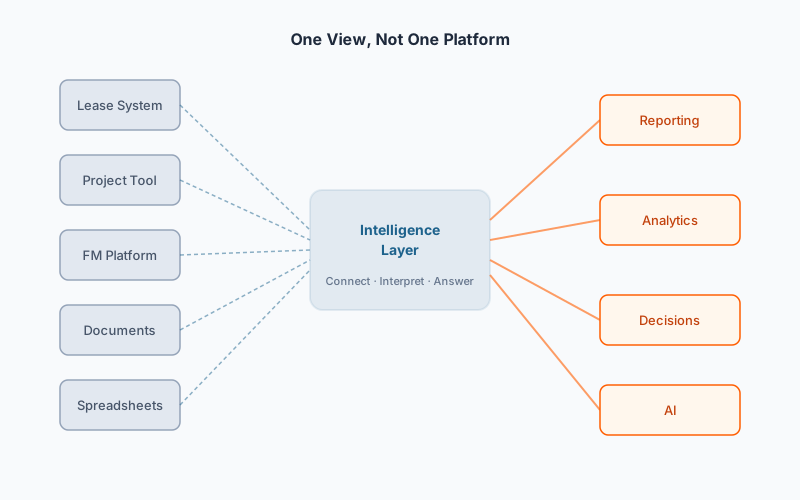
The alternative to consolidation is connection.
Keep the tools that work. Let service providers use their own platforms. Let the project management team use the tool they chose. Let lease data live where it lives, and documents where they are stored.
Then add a layer that can reach into these systems, interpret the data and documents together, and surface the reporting, analytics, and answers that leadership needs.
This approach has several practical advantages.
No migration required. Teams do not need to move data or retrain users. Existing systems continue to operate as they are.
Faster time to value. Instead of a multi-year consolidation effort, organizations can start getting answers in weeks rather than months.
Flexibility as the landscape changes. When service providers change, when tools are replaced, or when new systems are added, the connection layer adapts. There is no platform lock-in that forces future decisions.
AI and analytics where they add value. Rather than waiting for an IWMS vendor to add AI capabilities to their platform, organizations can apply intelligence across their entire data landscape — structured and unstructured — regardless of where it lives.
The Question Worth Asking
Corporate real estate technology decisions are significant investments of time, money, and organizational energy. Before committing to a multi-year consolidation, it is worth asking a simpler question.
Do we need one platform, or do we need one view?
If the goal is consolidated reporting, cross-portfolio analytics, and better decisions, there may be a shorter path than rebuilding the technology foundation. The data already exists. The systems already work. What is often missing is not a new platform, but the ability to make sense of what is already there.
That is a different problem, and it has a different solution.